Full text: China's Green Development in the New Era(9)
时间:2024-02-22 17:36 来源:网络整理 作者:墨客科技 点击:次
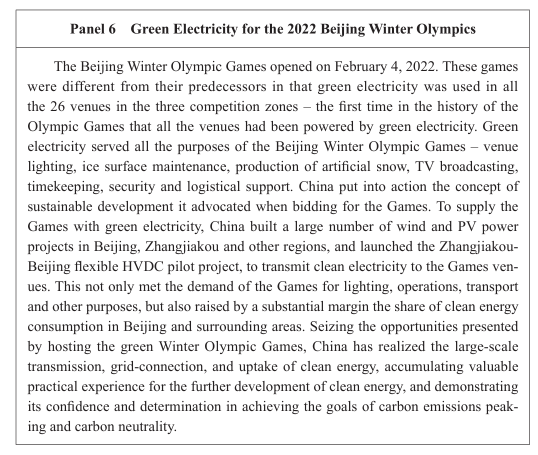
is an area that deserves more attention in the pursuit of green develop- ment. By upgrading the energy efficiency of transport equipment, China has accelerated the building of a green transport network, with optimizing the structure of energy consumption and improving the efficiency of or- ganization as its priorities, so that transport will be more eco-friendly, and travel will be more low-carbon. Optimizing the structure of transport. China has accelerated the con- struction of special railway lines, promoted the shift of freight transport from road to railway and waterway, and encouraged intermodal transport. In 2021, the railway and waterway freight volume accounted for 24.56 percent of the total in China, an increase of 3.85 percentage points over Panel 6 Green Electricity for the 2022 Beijing Winter Olympics The Beijing Winter Olympic Games opened on February 4, 2022. These games were different from their predecessors in that green electricity was used in all the 26 venues in the three competition zones – the first time in the history of the Olympic Games that all the venues had been powered by green electricity. Green electricity served all the purposes of the Beijing Winter Olympic Games – venue lighting, ice surface maintenance, production of artificial snow, TV broadcasting, timekeeping, security and logistical support. China put into action the concept of sustainable development it advocated when bidding for the Games. To supply the Games with green electricity, China built a large number of wind and PV power projects in Beijing, Zhangjiakou and other regions, and launched the Zhangjiakou- Beijing flexible HVDC pilot project, to transmit clean electricity to the Games ven- ues. This not only met the demand of the Games for lighting, operations, transport and other purposes, but also raised by a substantial margin the share of clean energy consumption in Beijing and surrounding areas. Seizing the opportunities presented by hosting the green Winter Olympic Games, China has realized the large-scale transmission, grid-connection, and uptake of clean energy, accumulating valuable practical experience for the further development of clean energy, and demonstrating its confidence and determination in achieving the goals of carbon emissions peak- ing and carbon neutrality. 2012. China has also emphasized the strategy of giving priority to urban public transport. By the end of 2021, there were 275 urban rail transit lines in operation in 51 cities, with a total track length of more than 8,700 kilometers. The length of exclusive bus lanes increased from 5,256 kilo- meters in 2012 to 18,264 kilometers in 2021. Promoting the green transformation of transport vehicles. China has vigorously promoted the use of new-energy vehicles in public trans- port, taxi service, environmental sanitation, logistics, distribution, civil aviation, airports, and Party and government institutions. By the end of 2021, the number of China’s registered new energy vehicles had reached 7.84 million, accounting for about half of the global figure. There were 508,900 new energy buses, accounting for 71.7 percent of the total num- ber of buses in China. There were 207,800 new energy taxis. China has continued the green transformation of mobile railway equipment. The proportion of internal combustion locomotives decreased from 51 percent in 2012 to 36 percent in 2021. China has also updated the pollutant dis- charge standards for motor vehicles, promoted the use of liquefied natural |