Full text: China's Green Development in the New Era(4)
时间:2024-02-22 17:36 来源:网络整理 作者:墨客科技 点击:次
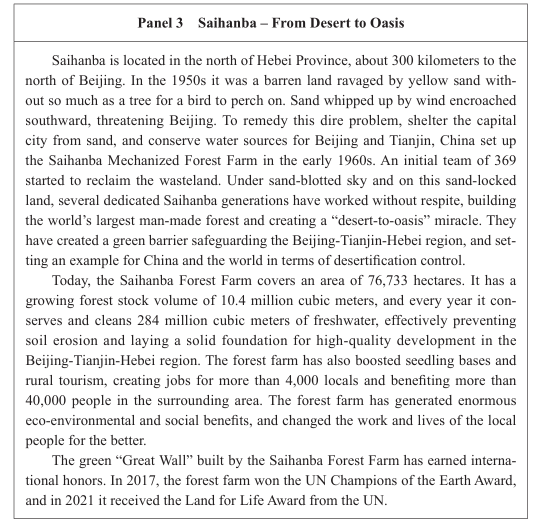
development. It works to build the key regions into pioneers and models in green development to boost green social and economic development across the country. Pushing for breakthroughs in environmental protection in the coordi- nated development of the Beijing-Tianjin-Hebei region. The strategy for the region’s coordinated development has been implemented, spurring the integrated development of areas such as transport, environment, industry Panel 3 Saihanba – From Desert to Oasis Saihanba is located in the north of Hebei Province, about 300 kilometers to the north of Beijing. In the 1950s it was a barren land ravaged by yellow sand with- out so much as a tree for a bird to perch on. Sand whipped up by wind encroached southward, threatening Beijing. To remedy this dire problem, shelter the capital city from sand, and conserve water sources for Beijing and Tianjin, China set up the Saihanba Mechanized Forest Farm in the early 1960s. An initial team of 369 started to reclaim the wasteland. Under sand-blotted sky and on this sand-locked land, several dedicated Saihanba generations have worked without respite, building the world’s largest man-made forest and creating a “desert-to-oasis” miracle. They have created a green barrier safeguarding the Beijing-Tianjin-Hebei region, and set- ting an example for China and the world in terms of desertification control. Today, the Saihanba Forest Farm covers an area of 76,733 hectares. It has a growing forest stock volume of 10.4 million cubic meters, and every year it con- serves and cleans 284 million cubic meters of freshwater, effectively preventing soil erosion and laying a solid foundation for high-quality development in the Beijing-Tianjin-Hebei region. The forest farm has also boosted seedling bases and rural tourism, creating jobs for more than 4,000 locals and benefiting more than 40,000 people in the surrounding area. The forest farm has generated enormous eco-environmental and social benefits, and changed the work and lives of the local people for the better. The green “Great Wall” built by the Saihanba Forest Farm has earned interna- tional honors. In 2017, the forest farm won the UN Champions of the Earth Award, and in 2021 it received the Land for Life Award from the UN. and public services, and strengthening joint prevention and control of en- vironmental problems. With the region as a focus, comprehensive efforts have been made to address overexploitation of groundwater in north China, with the groundwater level going down continuously since the 1980s being reversed. In this region, Xiongan New Area is being built according to forward-looking plans and high standards, with a focus on developing it into a destination for entities relocated from Beijing as their functions are non-essential to Beijing’s role as the capital. Xiongan will be built into an eco-friendly exemplar city of high-quality green development with a rational layout, a good balance of blue water, green areas, clean air, clear skies and urban facilities. In 2021, in 13 cities in the region, 74 percent of days had good air quality. This was an increase of 32 percentage points compared with 2013. Beijing has set an example in air quality control for the world. Promoting well-coordinated environmental conservation and avoid- ing excessive development while developing the Yangtze River Economic Belt. The Yangtze River is the mother river of the Chinese nation, and a powerhouse for China’s development. The restoration of the Yangtze River’s eco-environment is a top priority. China is coordinating economic development and environmental protection and building an economic belt epitomizing green development and harmony between humanity and nature. Taking advantage of the opportunities offered by industrial inte- gration, the Yangtze River Economic Belt is building a green industrial system and accelerating its green economic transformation. A tough bat- tle has been launched to protect and restore the eco-environment in the Yangtze River Basin: Intense efforts have been made to carry out the “4+1” project – the treatment of urban sewage and garbage, chemical pollution, agricultural non-point source pollution, ship pollution and tailing pond pollution; a comprehensive 10-year fishing ban in the Yangtze River Basin has been implemented; action has been taken to regulate banks develop- ment projects and remove illegal dykes. Since 2018, unauthorized structures along 162 kilometers of the river banks have been demolished, more than 12 square kilometers along the banks have been revegetated, and 4,533 hectares have been returned to water. The water quality at the state- monitored sections of the mainstream of the Yangtze River has reached Grade II level (the second best level) for the past two years. The pioneering role of the Yangtze River Delta region in green de- velopment. The construction of the Yangtze River Delta Integrated Green Development Demonstration Zone will be accelerated, to explore ways to translate eco-environmental strengths into social and economic benefits, and ways for the region to transition from coordinated project execution to regional integrated institutional innovation. With picturesque scenery, |