Full text: China's Green Development in the New Era(7)
时间:2024-02-22 17:36 来源:网络整理 作者:墨客科技 点击:次
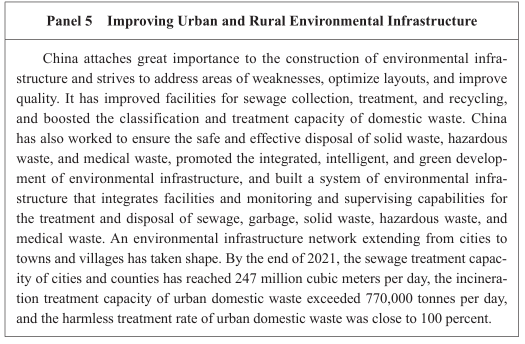
dealing with heavy air pollution have achieved remarkable results. The average PM2.5 density of China’s cities at prefecture level and above dropped from 46 micrograms per cubic meter in 2015 to 30 micrograms per cubic meter in 2021. On 87.5 percent of the days in 2021, people en- joyed good air quality. China is making the fastest progress in air quality improvement. With an accelerated pace in curbing industrial, agricultural and domestic pollution sources, and in regulating water ecological sys- tems, China has significantly reduced seriously polluted water bodies and sub-standard water bodies, and the safety of drinking water is ensured. In 2021, the proportion of surface water at or above Grade III in the country’s five-tier water quality system reached 84.9 percent. China has banned the import of foreign waste, fulfilling its goal of “zero import” of solid waste while basically bringing the threat of soil contamination under control. Brilliant blue skies are dotted with white clouds during the day; when the sun sets, twinkling stars pattern the firmament. The shores are Panel 5 Improving Urban and Rural Environmental Infrastructure China attaches great importance to the construction of environmental infra- structure and strives to address areas of weaknesses, optimize layouts, and improve quality. It has improved facilities for sewage collection, treatment, and recycling, and boosted the classification and treatment capacity of domestic waste. China has also worked to ensure the safe and effective disposal of solid waste, hazardous waste, and medical waste, promoted the integrated, intelligent, and green develop- ment of environmental infrastructure, and built a system of environmental infra- structure that integrates facilities and monitoring and supervising capabilities for the treatment and disposal of sewage, garbage, solid waste, hazardous waste, and medical waste. An environmental infrastructure network extending from cities to towns and villages has taken shape. By the end of 2021, the sewage treatment capac- ity of cities and counties has reached 247 million cubic meters per day, the incinera- tion treatment capacity of urban domestic waste exceeded 770,000 tonnes per day, and the harmless treatment rate of urban domestic waste was close to 100 percent. green and the waters are clean, with fish gliding under the clear water. People are breathing fresher air, drinking cleaner water, and eating safer food. Living in a beautiful environment, people can truly feel the happi- ness and beauty brought about by eco-environmental conservation. III. Adjusting and Improving the Industrial Structure China is committed to the philosophy of innovative, coordinated, green, open and shared development, and takes innovation-driven de- velopment as the driving force to create new momentum and build new strengths for economic development. China has placed rigid constraints on the exploitation of resources and the environment to promote compre- hensive adjustment of the industrial structure, and strengthened regional cooperation to optimize the spatial configuration of industry. As a result, China’s economy has registered a steady improvement in the quality of development while maintaining a reasonable pace of growth. 1. Vigorously developing strategic emerging industries China implements the innovation-driven development strategy. It takes scientific and technological innovation as the driving force and guarantee for adjustment of industrial structure and green and low-carbon transition of the economy and society and regards strategic emerging in- dustries as a key driver for economic development, reaping remarkable economic and social benefits as a result. China has intensified investment in scientific and technological innovation. The nation’s gross domestic research and development (R&D) spending grew from RMB1.03 trillion in 2012 to more than RMB2.8 trillion in 2021. Its R&D spending intensity, or the expenditure on R&D as a percentage of its GDP, rose from 1.91 percent in 2012 to 2.44 percent in 2021, approaching the average level of the Organization for Economic Cooperation and Development (OECD) countries. Chinese enterprises’ investment in R&D has continued to increase, accounting for more than 76 percent of the country’s total R&D investment. By the end of 2021, China’s energy conservation and environmental protection industry owned 49,000 valid invention patents, and the new energy industry held 60,000, 1.6 and 1.7 times more than in 2017. From 2011 to 2020, the number of patent applications filed by China for environment-related technology inventions was close to 60 percent of the world total, making it the most active country in environmental technology innovation. Emerging technologies have become the main props of China’s eco- nomic development. Thanks to accelerated efforts to implement emerg- ing technologies such as artificial intelligence (AI), big data, blockchain, and quantum communication, new products and business forms including intelligent terminals, telemedicine, and online education have been culti- vated, and their role in boosting growth has continued to increase. China’s digital economy ranks second in the world. During the 13th Five-year Plan period (2016-2020), the average annual growth rate of the added value of information transmission, software and information technol- ogy services reached 21 percent. The internet, big data, AI, 5G and other emerging technologies are deeply integrated with traditional industries, facilitating the integration of advanced manufacturing with modern ser- vices. The value-added output of high-tech and equipment manufacturing in 2021 accounted for 15.1 and 32.4 percent of that of industries above designated size, up 5.7 and 4.2 percentage points from 2012 respectively. China is on the way to realize the transformation and upgrading from “made in China” to “intelligent manufacturing in China”. China’s green industries continue to grow. The renewable energy in- dustry is growing rapidly, and China leads the world in the manufacture of clean energy generation facilities for wind and photovoltaic power. China produces more than 70 percent of the global total of polysilicon, wafers, cells and modules. The quality and efficiency of the energy-saving and environmental protection industries have continued to improve. China has developed a green technical equipment manufacturing system covering various sectors such as energy and water conservation, environmental protection, and renewable energy. The manufacturing and supply capacity of green technical equipment increases markedly while the cost keeps dropping. Technology in the fields of energy and water conserva- tion equipment, pollution control, and environmental monitoring meets the highest international standards. New forms and models of business continue to grow, such as comprehensive energy services, contract-based energy and water management, third-party treatment of environmental pollution, and comprehensive carbon emissions management services. In 2021, the output value of China’s energy conservation and environmental protection industries exceeded RMB8 trillion. Extensive pilot projects have been carried out at local level to explore methods and pathways to realize the value of eco-environmental products. New models of eco- friendly industry such as urban modern agriculture, leisure agriculture, eco-environmental tourism, forest healthcare, boutique homestays, and pastoral leisure complexes have witnessed rapid development. 2. Taking well-ordered steps to develop resource-based industries China continues to expand supply-side structural reform and reverse the extensive development model that relies heavily on resource con- sumption at the cost of high pollution and emissions. With environmental capacity as a rigid constraint, it has exerted tight control over the produc- tion capacity of energy-intensive industries and industries with high emis- sions or water consumption, in order to optimize its industrial structure. Easing overcapacity and closing down outdated production facili- ties. While protecting industrial and supply chains, China has taken ac- tive and well-ordered steps to ease overcapacity and close down outdated production facilities. Measures have been taken to curb industries that over-exploit resources and cause environmental damage, such as steel, ce- ment and electrolytic aluminum. A swap system has been introduced that allows producers to open equal or lower amounts of new capacity in re- turn for closures elsewhere. During the 13th Five-year Plan period (2016- 2020), China has removed more than 150 million tonnes of excess steel production capacity and 300 million tonnes of excess cement production capacity. Substandard steel products have been eliminated and almost all outdated production capacity in industries such as electrolytic aluminum and cement manufacturing has been removed. China is resolved to stop the blind development of energy-intensive projects with high emissions and outdated production techniques. It has raised the entry threshold for some key industries in terms of land use, environmental protection, energy and water conservation, technology, and safety. A differentiated system has been introduced for energy-intensive industries, covering differentiated electricity pricing, tiered electricity pricing, and punitive electricity pricing. For energy-intensive projects with high emissions and outdated production techniques, China applies a list-based management approach involving classification and dynamic monitoring. It resolutely investigates and punishes all projects that violate laws or regulations. In areas with problems of water shortage or overcon- sumption, restrictions are imposed on various types of new development zones and projects requiring high water consumption. 3. Optimizing regional distribution of industries Fully considering factors such as energy resources, environmental capacity, and market potential, China promotes the convergence of some industries in areas with more suitable conditions and greater potential for development. To expedite the formation of a modern and efficient indus- trial development configuration, it improves the distribution of productive forces and expands the division of industries and coordination across re- gions. Working to bring about a rational distribution of raw material indus- tries. China employs overall planning of resources such as coal and water and takes into consideration environmental capacity. Several modern coal chemical industry demonstration zones have been established in the cen- tral and western regions to pilot projects for technology upgrading in the coal chemical industry. A group of large-scale high-quality petrochemical industry bases has been constructed in coastal areas to promote the safe, green, intensive, and efficient development of the industry. Expanding the division of industries and cooperation across regions. China is seeking to establish and improve a benefit-sharing mechanism by employing the comparative strengths of every region, each relying on its own resources and environmental advantages, and on the foundations of industrial development. Multi-type and multi-mechanism industrial divi- sion and coordination have been strengthened, along with cooperation be- tween the east and the central and western regions, creating a framework of coordination, complementarity of strengths, and common development. Transferring industries and cooperation across regions are measures that help to break through the environmental and resource constraints that sti- fle industrial development. They also make room for the development of high-tech industries in the eastern region and propel the industrialization and urbanization process of underdeveloped areas in the central and west- ern regions, improving the balance and strengthening the coordination of regional development. IV. Extensive Application of Green Production Methods China has accelerated the building of a green, circular, and low-carbon economy. It practices green production methods, promotes the energy revolution, the economical and intensive use of resources, and cleaner production, and pursues synergy in the reduction of pollution and carbon emissions. All these efforts have contributed to the coordinated develop- ment and balanced progress of the economy, society, and environmental protection. 1. Promoting the green transformation of traditional industries In order to build a green, circular, and low-carbon production system, China has integrated the concept of green development into the entire life cycles of industry, agriculture and the service sector. To conserve energy, reduce emissions, raise efficiency, and facilitate the comprehensive green transformation of traditional industries, China has encouraged innovations in technology, models, and standards. Promoting the green development of industry. China is committed to establishing a green manufacturing system, and creating green factories, green industrial parks, green supply chains, and green product evaluation standards. In order to accelerate the building of green industrial chains and supply chains, China provides guidance for enterprises to achieve in- novations in the design of green products and adopt green, low-carbon and eco-friendly processes and equipment, and optimizes the spatial lay- out of enterprises, industries and infrastructure in industrial parks. Fol- lowing the principles of “coupling of industries, extended responsibility of enterprises, and circular use of resources”, it has promoted the transfor- mation of industrial parks, circular combination of industries and circular production in enterprises. China has transformed its major industries to achieve clean production, and carried out comprehensive inspections of clean production. It has promoted digital transformation across the board. The digital control rate of key processes in key areas increased from 24.6 percent in 2012 to 55.3 percent in 2021, and the penetration rate of digi- tal R&D and design tools increased from 48.8 percent to 74.7 percent in the same period. By the end of 2021, China hosted a total of 2,783 green factories, 223 green industrial parks, and 296 green supply chain manage- ment enterprises. The manufacturing sector has been significantly upgrad- ed for green production. Transforming the production methods of agriculture. China has cre- ated new systems and mechanisms for the green development of agricul- ture, expanded the functions of agriculture, explored the diversified rural values, and strengthened the protection and efficient use of agricultural resources. It has gradually improved the farmland protection system and the system of fallowing and crop rotation, put permanent basic cropland under special protection, and thereby made initial progress in containing the decline in the size of farmland. It has steadily advanced the conserva- tion of chernozem soil. The quality of farmland has been upgraded steadily throughout the country. Measures have been taken to save water for agri- cultural irrigation and reduce the volume of chemical fertilizers and pesti- cides used by targeting higher efficiency. In 2021, the irrigation efficiency was raised to 0.568. China has developed a circular agricultural economy by promoting circular agricultural production modes – integrating planting and breeding with processing, farming and animal husbandry with fishing, and production and processing with marketing. It has increased the utili- zation of agricultural waste as a resource. It has taken a coordinated ap- proach to promoting green and organic agricultural products, products with quality certifications and those with geographical indications, cultivating new breeds, improving product quality, fostering agricultural brands and standardizing agricultural production. China has implemented programs to protect agricultural products with geographical indications. There are now 60,000 types of green food and organic agricultural products across the country. The quality and safety standards of agricultural products have been steadily upgraded. The supply of high-quality agricultural products has increased significantly, which has effectively contributed to the up- grading of the whole industry, and generated higher incomes for farmers. Advancing the green transformation of the service sector. China has actively cultivated green firms of business circulation, and launched a campaign to create green shopping malls. Nationwide, a total of 592 green shopping malls had been built by the end of 2021. China has contin- ued to improve the energy efficiency of the information service industry, with some world-leading green data centers. To accelerate the reduc- tion, standardization and recycling of express delivery packages, it has upgraded and improved the express delivery packaging standard system. To promote the green development of e-commerce enterprises, it has given guidance for producers and consumers to use renewable and degra- dable express delivery packages. By the end of 2021, 80.5 percent of e-commerce parcels were free of secondary packaging, all express delivery packages were sealed with thinner (45mm) tape, and all transit bags used in the sector were renewable. China has promoted the green development of the convention and exhibition industry by formulating green standards and facilitating the repeated use of facilities. China has significantly reduced paper usage by introducing electronic railway tickets nationwide and encouraging elec- tronic invoicing. In the catering industry, disposable tableware is being phased out. Guest houses and hotels have been encouraged not to offer disposable items as part of their services. 2. Promoting green and low-carbon energy China applies the principle of building the new before discarding the old in a well-planned way. With growing capacity to ensure energy supply, it has moved faster to build a new energy system. The propor- tion of clean energy sources has increased significantly. Success has been achieved in the green and low-carbon transformation of the country’s en- ergy mix. Vigorously developing non-fossil energy. China has made rapid pro- gress in building large-scale wind and photovoltaic power stations on in- fertile and rocky terrain and in deserts. It has steadily developed offshore wind farms, actively promoted rooftop photovoltaic power generation in urban and rural areas, and encouraged distributed wind power generation in rural areas. China has built a structured matrix of large hydropower stations in the basins of major rivers, especially those in the southwest. In accordance with local conditions, it has developed solar, biomass, geothermal and ocean energy, and power generation through urban solid waste incineration. It has developed nuclear power in a safe and orderly manner. Committed to innovation-driven development, China has worked on developing hydrogen energy. It has accelerated the construction of a new power system to adapt to the steady increase in the proportion of new energy. To promote the efficient use of renewable energy, it has carried out appraisals of relevant parties’ performance in meeting the set goals for consumption of power generated from renewable energy. The proportion of clean energy sources in total energy consumption increased from 14.5 percent in 2012 to 25.5 percent by the end of 2021, and the proportion of coal decreased from 68.5 percent to 56 percent over the same period. The installed capacity of renewable energy was more than one billion kilowatts, accounting for 44.8 percent of China’s overall installed capac- ity. The installed capacity of hydropower, wind power, and photovoltaic power each exceeded 300 million kilowatts, all ranking the highest in the world. Advancing the clean and efficient use of fossil energy. To promote the clean and low-carbon development of coal-fired power, China has up- graded coal-fired power plants to conserve resources, reduce carbon emis- sions and make their operation more flexible, and transformed heating |