Full text: China's Green Development in the New Era(3)
时间:2024-02-22 17:36 来源:网络整理 作者:墨客科技 点击:次
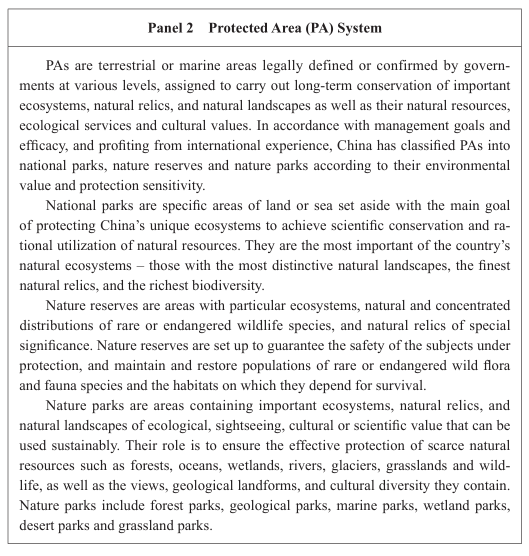
the Northeast, North, South, and Coastal Shelterbelts. Carrying out major projects for the conservation and restoration of key national ecosystems. With a focus on major national eco-environmental functional areas, ECRLs and PAs, China has launched projects for holistic conservation and restoration of mountains, rivers, forests, farmland, lakes, grasslands and deserts, taking comprehensive and systematic measures Panel 2 Protected Area (PA) System PAs are terrestrial or marine areas legally defined or confirmed by govern- ments at various levels, assigned to carry out long-term conservation of important ecosystems, natural relics, and natural landscapes as well as their natural resources, ecological services and cultural values. In accordance with management goals and efficacy, and profiting from international experience, China has classified PAs into national parks, nature reserves and nature parks according to their environmental value and protection sensitivity. National parks are specific areas of land or sea set aside with the main goal of protecting China’s unique ecosystems to achieve scientific conservation and ra- tional utilization of natural resources. They are the most important of the country’s natural ecosystems – those with the most distinctive natural landscapes, the finest natural relics, and the richest biodiversity. Nature reserves are areas with particular ecosystems, natural and concentrated distributions of rare or endangered wildlife species, and natural relics of special significance. Nature reserves are set up to guarantee the safety of the subjects under protection, and maintain and restore populations of rare or endangered wild flora and fauna species and the habitats on which they depend for survival. Nature parks are areas containing important ecosystems, natural relics, and natural landscapes of ecological, sightseeing, cultural or scientific value that can be used sustainably. Their role is to ensure the effective protection of scarce natural resources such as forests, oceans, wetlands, rivers, glaciers, grasslands and wild- life, as well as the views, geological landforms, and cultural diversity they contain. Nature parks include forest parks, geological parks, marine parks, wetland parks, desert parks and grassland parks. to deal with problems by addressing their root causes. It has carried out shelterbelt and natural forest protection and restoration programs such as the shelterbelt program in northeast China, north China and northwest China, programs returning marginal farmland to forests and grasslands, the program for ecological restoration of abandoned mines, the Blue Bay environment improvement initiative, the coastal belts protection and restoration program, the comprehensive management of the Bohai Sea water environment, the conservation and restoration of mangrove for- ests, and other restoration and rehabilitation projects of significant eco- environmental importance. China has carried out large-scale afforestation projects, steadily increased the area of forests, grasslands, wetlands, rivers and lakes, and effectively reversed the trend of desertification. From 2012 to 2021, 64 million hectares of trees were planted. Dur- ing this period, desertification prevention and control was carried out over 18.53 million hectares of land, and 40 million hectares of land were im- proved through sowing grass, and more than 800,000 hectares of wetland were added or restored. In 2021, the forest coverage ratio hit 24 percent, while the forest stock volume grew to 19.5 billion cubic meters. Both figures represented 30 consecutive years of growth, making China the country with the highest growth in forest resources and the largest area of man-made forest. China is also the first country to realize zero net land degradation – its desertified and sandified areas are both shrinking, and this is helping the world to reach the global goal of zero net land degrada- tion in 2030. Since 2000, China has led the world in greening the planet, contributing around one fourth of the newly added green areas in the world. 3. Promoting the green development of key regions China gives full play to the guiding role of major strategies for re- gional development and the implementation of these strategies, based on prioritizing eco-environmental conservation and promoting green |