山石网科立足2022技术发展,洞见2023网络安全技术趋势(3)
时间:2023-01-28 07:50 来源:网络整理 作者:采集插件 点击:次
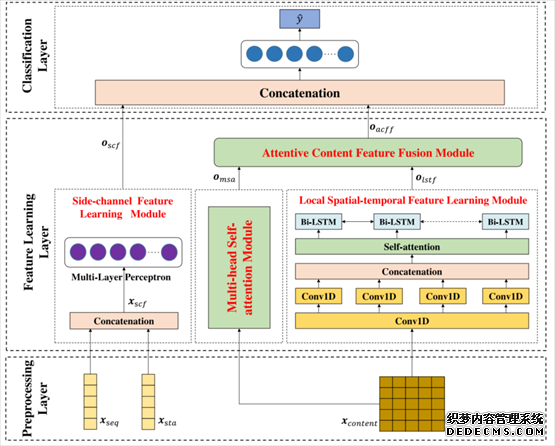
为了解决这一问题,北京航空航天大学的一个研究团队[6]提出了一种新的暗网流量分类和应用识别的自关注深度学习方法DarknetSec。DarknetSec还可以从有效载荷统计信息中提取侧信道特征,以提高其分类性能。在CICDarknet2020数据集上评估,实现了92.22%的多分类精度和92.10%的f1评分。此外,DarknetSec在应用于其他加密流量分类任务时保持了较高的准确性。
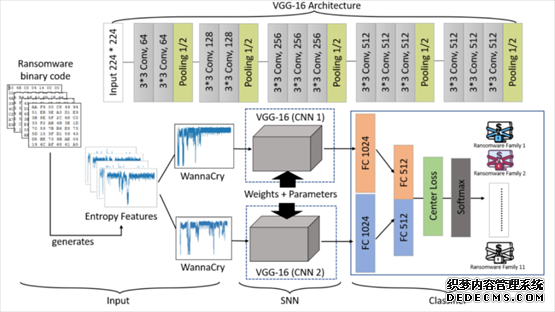
10,拒绝被勒索软件勒索 勒索软件在过去几年对政府、金融、关键基础设施构成了严重危害。对勒索软件进行快速、准确地检测是该领域的重要研究课题。 采用深度神经网络检测勒索软件是现在的技术趋势,但是勒索软件的训练数据稀缺导致深度神经网络的使用存在挑战。新西兰的一个研究团队[7]提出一种基于少样本元学习模型的Siamese神经网络,不仅可以检测勒索软件,还能对其进行分类。主要原理是通过勒索软件二进制文件获得与其他勒索软件签名相关联的熵特征。通过实验,该方法检测勒索软件的F1值超过0.86。
四、结语 未来,山石网科将用远见超越未见,用网络安全的技术创新,持续护航国家安全。 参考文献: [1] Barros, Pedro H., Eduarda T. C. Chagas, Leonardo B. Oliveira, Fabiane Queiroz, and Heitor S. Ramos.“Malware‐SMELL: A Zero‐shot Learning Strategy for Detecting Zero‐day Vulnerabilities.” Computers & Security 120 (September 1, 2022): 102785. https://doi.org/10.1016/j.cose.2022.102785. [2] Erlacher, Felix, and Falko Dressler.“On High-Speed Flow-Based Intrusion Detection Using Snort-Compatible Signatures.” IEEE Transactions on Dependable and Secure Computing 19, no. 1 (2022): 495–506. https://doi.org/10.1109/TDSC.2020.2973992. [3] Wang, Zihao, Kar Wai Fok, and Vrizlynn L. L. Thing.“Machine Learning for Encrypted Malicious Traffic Detection: Approaches, Datasets and Comparative Study.” Computers & Security 113 (February 1, 2022): 102542. https://doi.org/10.1016/j.cose.2021.102542. [4] Xiong, Chunlin, Tiantian Zhu, Weihao Dong, Linqi Ruan, Runqing Yang, Yueqiang Cheng, Yan Chen, Shuai Cheng, and Xutong Chen.“Conan: A Practical Real-Time APT Detection System With High Accuracy and Efficiency.” IEEE Transactions on Dependable and Secure Computing 19, no. 1 (2022): 551–65. https://doi.org/10.1109/TDSC.2020.2971484. [5] Wei W, Liu L. Gradient Leakage Attack Resilient Deep Learning[J]. IEEE transactions on information forensics and security, 2022(17-):17. [6] Lan, Jinghong, Xudong Liu, Bo Li, Yanan Li, and Tongtong Geng.“DarknetSec: A Novel Self-Attentive Deep Learning Method for Darknet Traffic Classification and Application Identification.” Computers & Security 116 (May 1, 2022): 102663. https://doi.org/10.1016/j.cose.2022.102663. [7] Zhu, Jinting, Julian Jang-Jaccard, Amardeep Singh, Ian Welch, Harith AI-Sahaf, and Seyit Camtepe.“A Few-Shot Meta-Learning Based Siamese Neural Network Using Entropy Features for Ransomware Classification.” (责任编辑:admin) |
- 上一篇:农村用水安全一刻不能松
- 下一篇:久坐族、低头族,快来看看,你是否在过度使用